Affiliate disclosure: Some links on this page may be affiliate or sponsored links. We may earn a commission at no extra cost to you. This does not change our editorial criteria.
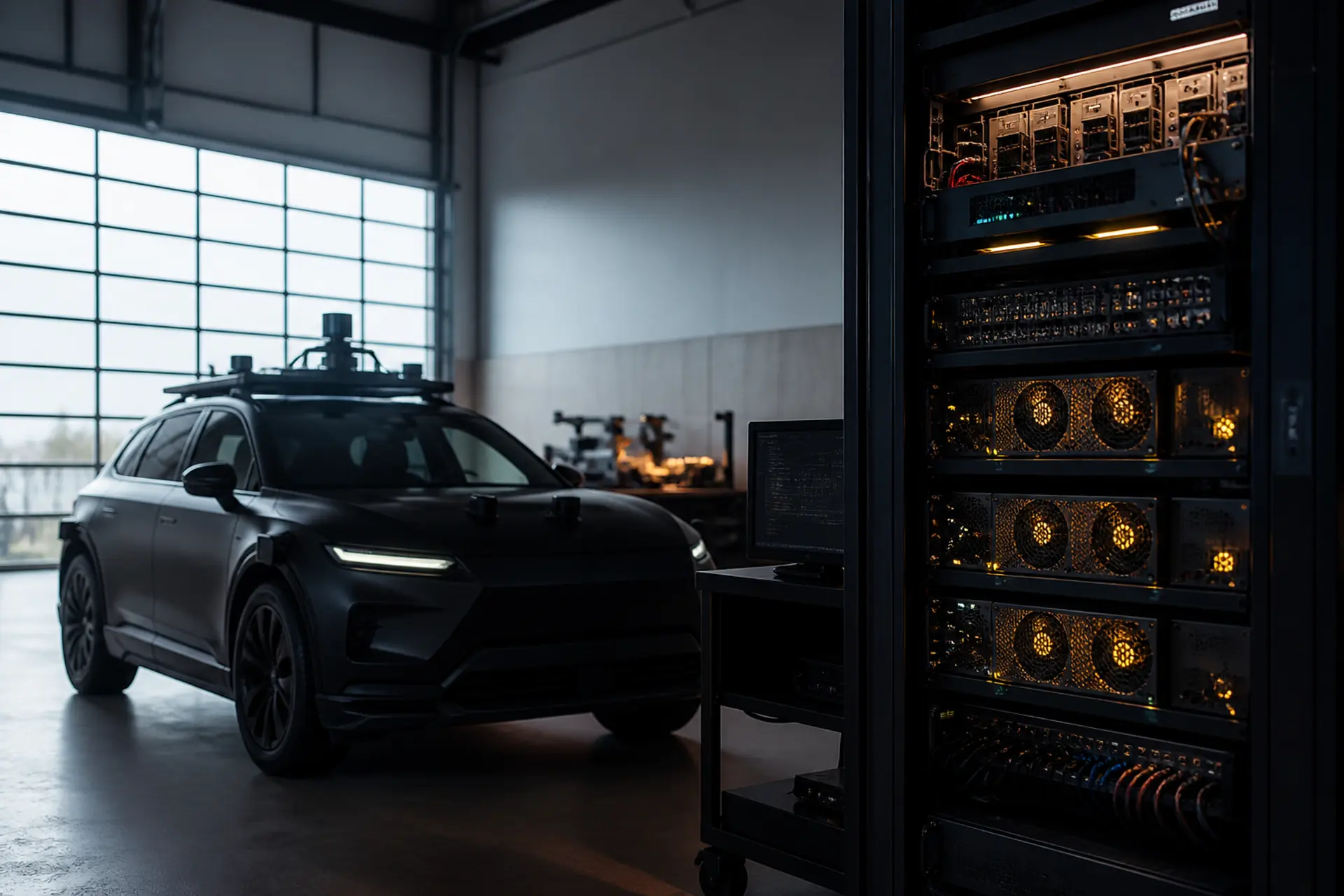
GPU cloud for AV simulation and perception training
This page is a beginner guide for self-driving software teams who need extra computers to practice driving in a simulator and to train camera and lidar models. A GPU is a graphics processing unit: a chip that is very good at the math in 3D simulation and in teaching neural networks (computer models that learn from examples). GPU cloud means you rent those chips by the hour, then shut them off when the campaign ends.
Who it is for: the person buying compute for simulation miles or a perception retrain. You do not need to be a vehicle-safety engineer to follow this page.
This is about buying compute for simulation and model training. It is not a safety case. It is not a vehicle certification. It is not a claim that any model is road-ready. Rented GPUs do not make a driving stack legal to deploy.
You rent GPUs when a new scenario pack will last a quarter, a perception model needs a retrain, or a sensor-fusion experiment should not wait on a hall of cards. If the same nodes replay logs overnight every night, the fleet archive never leaves a boundary, and you already know the cluster will still be there in three years, a dedicated powered site starts to beat a rental meter. Find powered land when you need a site. Rent GPUs when you need capacity now.
You rent GPUs when simulation miles are a campaign, not a nightly habit
Closed-loop simulation means the software "drives" in a virtual world and the world reacts. Scenario replay means running recorded or invented situations again and again. At campaign scale those jobs split well across many machines.
NVIDIA DRIVE Simulation documents reconstruction of real-world scenes, synthetic scenario generation, and closed-loop validation at scale. CARLA is an open-source urban driving simulator. Its packaged install guide recommends a dedicated NVIDIA GPU with at least 8 GB of VRAM. VRAM is the GPU's own memory. AV buyers should ask GPU clouds for CUDA drivers (NVIDIA's GPU software layer), enough device memory to hold the scene, and a machine shape that does not change mid-run.
Cloud rental works for a new scenario set or a one-off replay. It fails when every nightly regression lands on the same partition. One campaign: rent. A queue that never drains: cluster.
Physics and airflow-shaped scientific computing is a different buyer page: GPU cloud for physics, climate, and CFD.
You rent GPUs when a perception model needs a retrain and the logs are nearby
Perception here means teaching a model to see: cameras, lidar (laser scanning), radar, and occupancy (what space is filled). That is ordinary GPU training with an extraordinary dataset. You want several GPUs in one machine, a fast local cache, and a pipeline that does not re-download the fleet every pass through the data.
NVIDIA TensorRT is documented as the inference library teams use once a trained network has to run fast on NVIDIA GPUs. Inference means using the trained model, not teaching it. Training still looks like PyTorch or equivalent on CUDA. Architecture sweeps (trying different model shapes) can be rental. Always-on retrains on a growing archive are how utilization stops looking temporary.
The buyer constraint is usually not raw speed. It is where the logs live and whether the region matches the data policy. A cheaper distant GPU that misses a train window is a failed rental. Keep working sets in the region the archive already uses.
You rent GPUs when fusion training or synthetic data is a burst. Production replay often is not.
Sensor fusion means combining time-aligned camera, lidar, radar, and vehicle-state streams into one model. The limiter is usually the copy, not the chip. Reading a quarter of multi-sensor logs into a GPU machine once is a project. Doing it every experiment is how the bill leaves the GPU line. If the archive is proprietary and the studies are continuous, it wants to sit next to hardware you do not turn off.
Synthetic data means computer-generated images used as extra training examples. NVIDIA Omniverse Replicator is documented as a framework for physically accurate 3D data used to train perception networks, built on OpenUSD (a common 3D scene format). Generating that data is a burst: spin GPUs, write the set, shut the meter off. These tools produce training and test data. They do not certify a vehicle. Interruptible capacity (cheaper GPUs the provider can take back) is fine for public checkpoints. It is a poor place for the only copy of a private log set.
What to check before you rent
Start with who shares the machine and what class the data is. Fleet logs are video of public roads, locations, and sometimes cabin data. Shared notebook GPUs in a random region are the wrong shape. Ask for a VPC (a private network slice), audit logs, and a region you can defend.
Confirm CUDA drivers, GPU memory, and how GPUs in one server connect. CARLA-class sim and DRIVE Simulation-class closed-loop work are different products from a single notebook card. Scenario packs are rental. Nightly replay that must finish before the next software train is a dedicated partition.
Separate training from in-vehicle compute. NVIDIA DRIVE AGX is documented as the on-vehicle developer kit path. A rented cloud GPU is not a substitute for that box, and it is not a type-approval. None of this is legal advice.
GPU cloud partners (placeholder)
Partner rows below are placeholders until terms are signed. No live rates. No outbound URLs. When links go live, they will use rel="sponsored".
| Best for | GPU types | Notes |
|---|---|---|
| Partner TBD - CARLA-class and closed-loop sim bursts | NVIDIA data-center GPUs | Placeholder. Confirm CUDA, GPU memory, and whether the job can be taken back. rel="sponsored" when live. |
| Partner TBD - perception and fusion training | Multi-GPU NVIDIA nodes | Placeholder. Ask how GPUs connect, local cache, and whether the machine shape holds. rel="sponsored" when live. |
| Partner TBD - synthetic data generation | High-memory NVIDIA GPUs | Placeholder. Private network or single-tenant, and log residency, first. rel="sponsored" when live. |
This table is not a ranking. It will reflect partner relationships once partners exist. Hourly prices are omitted on purpose; they vary and go stale. Powered Lands does not claim any placeholder row is safety-certified.
GPU cloud pricing varies. Verify live rates.
There is no honest single dollar-per-hour number on this page. List prices move with GPU type, region, and whether you pay only when the machine is on. Quoted "from" rates often skip storage, data transfer, and idle reservations. See the GPU cloud pricing index for how we talk about rates. Treat every public figure as stale until you re-check the provider. We will not invent hourly prices here.
Safety-critical software is not a cloud product name
Perception models and sim miles are compute. They are not a determination that a vehicle is safe to operate. GPU cloud is usable for research, replay, and training when the provider's posture matches legal review. It is not a shortcut around your safety process, and this page does not certify ISO, UNECE, NHTSA, or any other regime. Multi-sensor logs are large. Keep working sets in the same region as the GPUs. If leftover identifiers can remain in video, treat the environment as if it still holds sensitive recordings.
When GPU rental stops working
Rental stops working when utilization is high and predictable, the hardware shape is stable, and the next constraint is megawatts (a large unit of electrical power) and a site, not another login. The alternative is powered land: a development site with a credible path to large-load electricity. Browse the U.S. data center directory, then read when GPU clusters need powered land. Hybrid is normal. Rent the scenario packs. Site the overnight replay that never stops.
Find powered land when you need a site. Rent GPUs when you need capacity now.
Related
- GPU cloud for physics, climate, and CFD
- When GPU clusters need powered land
- GPU cloud for VFX, rendering, and AI video
FAQ
Why do AV teams rent GPUs instead of using an on-prem cluster?
Because simulation campaigns and perception retrains are bursty, and CARLA-class or DRIVE Simulation-class work wants CUDA capacity this week. On-prem still wins when the same nodes replay logs every night. Rent the spikes unless you already own a busy cluster.
Can CARLA run on GPU cloud?
Yes, as a compute choice, if the instance meets the GPU memory CARLA's install guide calls for and the image has the drivers the build expects. Confirm VRAM with the provider before you move a production replay.
Does renting GPUs make an AV stack safe to deploy?
No. Rental is capacity for simulation and training. It is not a safety case, not a vehicle certification, and not a substitute for in-vehicle compute such as DRIVE AGX.
Should fleet logs sit on shared spot GPUs?
Only if a kill mid-run is acceptable and the data class allows that tenancy. Private logs and deadline replay want dedicated or on-demand shapes, isolation, and a region you can defend.
What is the alternative when rental queues and power become the limit?
Look at powered land and the data center directory, and use the powered-land GPU guide. This page does not publish rates. Start from the pricing index, then re-check the provider. The product you need has shifted from cards to a site with power.
Sources
- NVIDIA DRIVE
- NVIDIA DRIVE Simulation
- CARLA Simulator
- CARLA quick start (GPU requirements)
- NVIDIA Omniverse Replicator
- NVIDIA TensorRT
- NVIDIA DRIVE AGX
- What is powered land
- U.S. data center directory
- Powered Lands data center map
Need land or power instead? See the map or contact.