Affiliate disclosure: Some links on this page may be affiliate or sponsored links. We may earn a commission at no extra cost to you. This does not change our editorial criteria.
Rent NVIDIA H100 GPUs
This page is a beginner guide to the NVIDIA H100, a data-center graphics chip that GPU clouds rent by the hour. A GPU is a graphics processing unit: a chip that is very good at the same math thousands of times at once. GPU cloud means you rent those chips, then shut them off when the job ends.
Who it is for: founders, research leads, and the person buying compute who has been told "we need H100s" and wants the plain-English version first. You do not need to be an ML engineer to follow this page.
The H100 is NVIDIA's Hopper-generation workhorse. Hopper is the product family name for this generation of NVIDIA data-center GPUs. Teams rent it to teach large language models, to run those models as a service, and to fine-tune (teach an existing model a smaller job). You rent H100s when you need that class of chip this week and you can turn the meter off. If the same H100s would stay busy for years, the next problem is usually electricity and a site. That is powered land.
What an H100 actually is
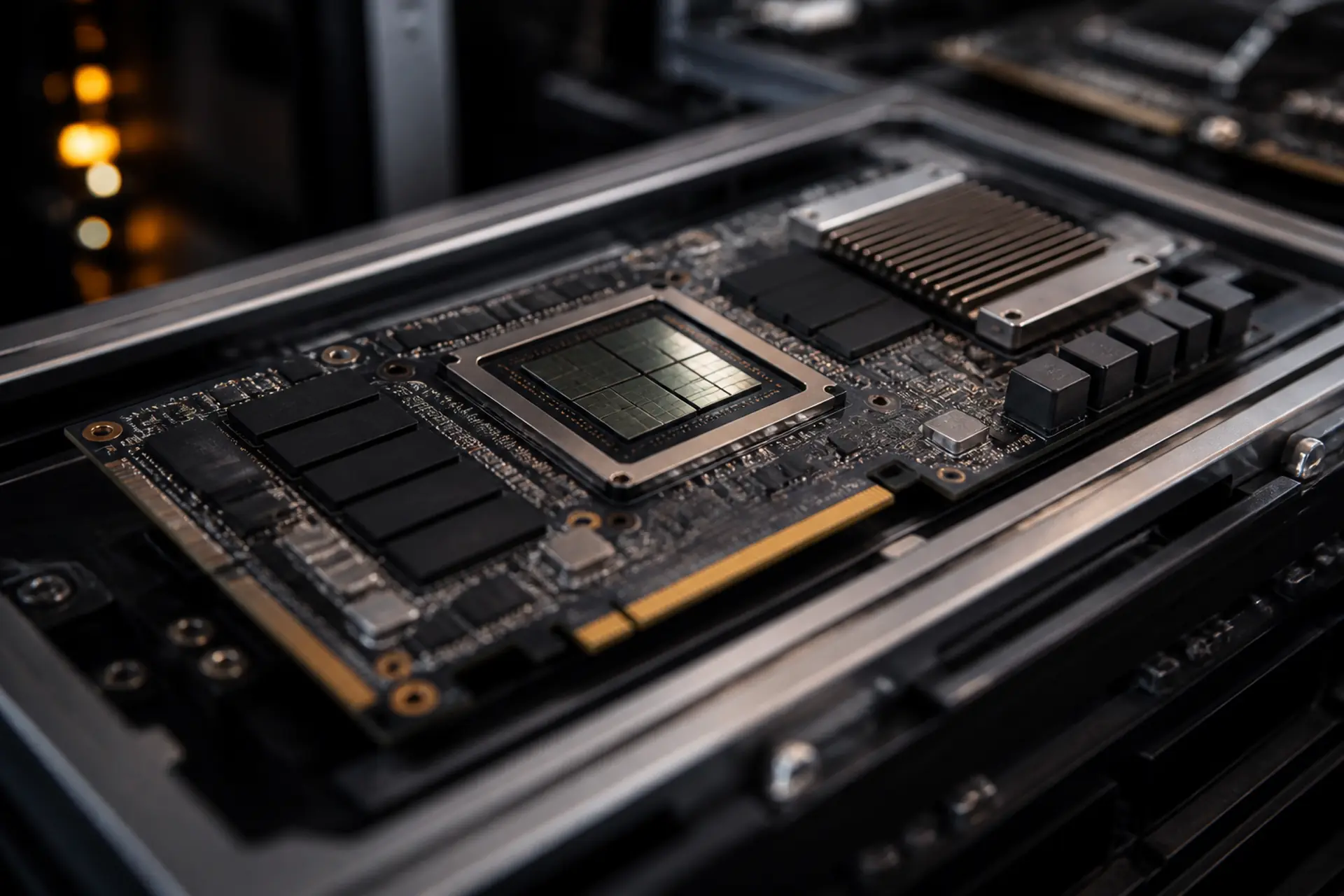
Think of the H100 as a very fast calculator with its own memory. The memory on the GPU package is HBM (high bandwidth memory): fast chips sitting next to the compute units, not the server's ordinary RAM. NVIDIA's H100 page lists an 80 GB version and a 94 GB H100 NVL version. Cloud menus often just say "H100." Ask how many gigabytes are on the card you will actually get.
CUDA is NVIDIA's software layer that lets programs use NVIDIA chips. PyTorch, NVIDIA NeMo, and most Hugging Face language-model code expect CUDA drivers on the machine. Tensor Cores are special units on the GPU that do matrix math quickly. TF32 (Tensor Float 32) is a number format those cores use so training can run faster than full 32-bit math. The H100 also adds FP8, a smaller 8-bit format, and a Transformer Engine, which is extra hardware aimed at the transformer math inside language models.
NVLink is NVIDIA's fast link between GPUs in the same server. Talking over NVLink is much quicker than sending data through the rest of the computer. SXM is the dense tray style used in many 8-GPU training boxes. PCIe is the card that plugs into a normal slot. They are both called H100. They are not the same product when several chips have to train together.
MIG (Multi-Instance GPU) means the provider can slice one H100 into smaller isolated pieces. A slice is fine for a notebook experiment. It is a poor fit if you paid for a whole H100 and received a seventh of one.
You rent H100s to teach a large model
Training means showing a model huge amounts of data so it learns patterns. A large language model (LLM) predicts text. Full training usually needs many matching GPUs that can share work. That is the job that made "we need H100s" a procurement sentence. The workload checklist lives on rent GPUs for LLM training.
You rent H100s for training when the model size is still moving and you do not know how many hours a run will take. Reserve matching H100s in one region. Copy the dataset next to them. Save checkpoints (snapshots of the model) often. Shut the meter off when you have a result or a failure you can debug.
Ask how the GPUs in one server talk to each other. An "8x H100" machine with slow links behaves like a much weaker box. Ask where checkpoints go. If every save crosses the public internet, the run will stall.
You rent H100s to run or adapt a model that already exists
Inference means using a trained model to answer questions. The model has to fit in GPU memory, or be split across several GPUs. H100 80 GB holds a lot of models that will not start on a smaller card. Serving engines such as vLLM still need NVIDIA drivers and CUDA. If people are waiting on answers, see GPU rental for LLM inference.
Fine-tuning starts from a model that already knows language and teaches it your smaller job. LoRA-style methods (which train a small extra set of weights) often fit on one high-memory GPU. That shorter rental is GPU rental for model fine-tuning.
If the model or the context window is memory-bound, the next chip in the same Hopper family is the H200, which NVIDIA lists with 141 GB of faster HBM3e. If you only need the previous generation, the A100 is still widely rented.
Simulation yes. Rendering only if the pipeline already needs this chip.
Scientific codes with a CUDA build can use H100s for physics, climate, and airflow campaigns. Confirm the solver actually runs on NVIDIA GPUs. That checklist is GPU cloud for physics, climate, and CFD. Molecule and gene work lives on GPU cloud for life sciences.
H100s can render if the renderer speaks CUDA or OptiX (NVIDIA's ray-tracing engine). Most show bursts still look for cheaper workstation-class cards.
What to check before you rent
Start with memory and count, not the famous name. Can one GPU hold the piece of the model you intend to put on it? Confirm CUDA drivers, and that PyTorch or NeMo will actually run.
Ask SXM or PCIe, how NVLink is wired, and whether you get a whole GPU or a MIG slice. Ask about preemption. Spot (interruptible) GPUs are cheaper and can vanish. They are fine if you checkpoint often. They are a bad fit for a deadline run. Egress is the fee for copying data out of the cloud. Moving a training set every experiment is how the bill leaves the GPU line.
GPU cloud partners (placeholder)
Partner rows below are placeholders until terms are signed. No live rates. No outbound URLs. When links go live, they will use rel="sponsored".
| Best for | GPU types | Notes |
|---|---|---|
| Partner TBD - multi-GPU H100 training nodes | NVIDIA H100, often 8-GPU SXM | Placeholder. Confirm NVLink, memory size, and checkpoint storage. rel="sponsored" when live. |
| Partner TBD - H100 inference and fine-tunes | NVIDIA H100 with enough GPU memory | Placeholder. Whole GPU vs MIG slice, and region, first. rel="sponsored" when live. |
| Partner TBD - short experiments | On-demand NVIDIA H100 | Placeholder. A meter that can hit zero matters more than brand. rel="sponsored" when live. |
This table is not a ranking. It will reflect partner relationships once partners exist.
GPU cloud pricing varies. Verify live rates.
There is no honest single dollar-per-hour number on this page. List prices move with GPU type, region, form factor, and whether you pay only when the machine is on. Quoted "from" rates often skip storage, data transfer, and idle reservations. See the GPU cloud pricing index for how we talk about rates. We will not invent hourly prices here. Treat every public figure as stale until you re-check the provider.
Compare hours you will actually run. A three-week training job is not the same product as a chatbot that answers all year.
When GPU rental stops working
Rental stops working when utilization is high and predictable, the hardware mix is stable, and the next constraint is megawatts and a site, not another login. A megawatt is a large unit of electrical power. You are then running a training floor that happens to live on someone else's building.
The honest alternative is powered land: a development site with a credible path to large-load electricity. Browse the U.S. data center directory, then read when GPU clusters need powered land. Hybrid is normal. Rent the experiments and the one-time pre-trains. Site the H100s that never turn off.
Find powered land when you need a site. Rent GPUs when you need capacity now.
Related
FAQ
What is an NVIDIA H100 in plain English?
It is a data-center GPU from NVIDIA's Hopper family. Clouds rent it by the hour because it has enough of its own memory, and fast links between chips, to teach and run large language models. It is not a laptop graphics card.
Do I need H100s, or will a smaller GPU work?
Start from memory, not the brand. A small fine-tune or a small assistant may fit on an A100 or even one GPU. Full training of a serious language model usually wants several matching H100-class chips. If the model is memory-bound, look at the H200.
Is every "H100" in a cloud catalog the same?
No. Memory size, SXM vs PCIe, NVLink wiring, and whether you get a whole GPU or a MIG slice all change the product. Ask those four questions before you compare hourly quotes.
Should I rent H100s on spot instances?
Only if you save checkpoints often and can restart. Spot machines can disappear. Deadline training and customer-facing inference usually want on-demand or dedicated nodes.
When is owning H100s cheaper than renting?
When the same shape would be busy most hours for a planning horizon in years, not for one run. Count real hours. We do not publish dollar-per-hour rates. Use the pricing index, then re-check the provider.
What if the limiter is power and a site, not another H100?
Then rental is the wrong product. Use the powered-land GPU guide and what powered land is.
Sources
- NVIDIA H100 GPU
- NVIDIA Hopper architecture
- NVIDIA NVLink
- NVIDIA Tensor Cores
- NVIDIA CUDA Toolkit
- What is powered land
- U.S. data center directory
- Powered Lands data center map
Need land or power instead? See the map or contact.